




Food Delivery Data Scraping
iWeb Scraping delivers recruitment and market intelligence to efficiently make well-informed decisions that helps in menu intelligence and competitor research.


Trusted by Global Technology Leaders
Structured Food & Restaurant Data Scraping for Smarter Business Decisions
The restaurants need to remain competitive in the food and restaurant sector. Hence, they require accurate and timely competitive market intelligence. Consequently, they can use food and restaurant data scraping to compile structured data. This includes data about menu items, reviews, ratings, prices, and restaurant locations from various sources. It also includes public-facing restaurant websites, menus, review sites, online ordering apps, and restaurant directories.
iWeb Scraping delivers dependable data sets that enable companies to benchmark competitors, determine competitive market pricing, analyze market trends, optimize menu offerings, and make data-driven decisions that lead to growth, satisfied customers, and effective operational strategies.
What is Food & Restaurant Data Scraping?
Food and restaurant data scraping is the scraping publicly available data (such as menu information, prices of menu items, customer reviews, ratings, restaurant location, and most popular dishes) from restaurant websites, review websites, online ordering applications, and food directories to gather structured information to enable businesses to develop more effective and efficient menu strategies. Data collected through food and restaurant data scraping allows organizations to benchmark competitors using current market pricing and analyze and assess competitive market trends to facilitate growth.
Core Benefits of Food & Restaurant Data Scraping
Food and restaurant data scraping delivers a wide range of benefits. It transforms large volumes of public market data into actionable insights.
Real-Time Menu & Price Visibility
Get real-time visibility to menu changes, price changes, promotional pricing, and other important market data for many, many restaurants to help keep up with changes in market trends and availability.

Faster Competitive Decisions
Instantly access structured competitive data so you can quickly change your pricing strategy as well as menu items and marketing campaigns, allowing you to make better decisions more quickly.
Improved Menu & Assortment Strategy
Examine top-selling menu items, food & restaurant format preferences, and market trends to best optimize your menu and correctly develop your overall inventory and assortment strategy.
Better Location & Demand Analysis
Track your geographic insights on restaurant popularity, delivery information, and local demand so you can make better location decisions for your next expansion.

Reduced Manual Market Research
Eliminate the need for manually tracking various types of restaurant data by automating multiple streams of data, assuring the recruitment manager has the most accurate, current restaurant and food service market knowledge.

Scalable Restaurant Intelligence
Collect the highest volume of restaurant and menu datasets in multiple markets, platforms, and regions without sacrificing the integrity or accuracy of data.
Use Cases of Food & Restaurant Data Scraping
Food and restaurant data scraping can help in market, menu, and competition analysis by providing businesses with structured data to support their decision-making process.
Menu & Pricing Intelligence
Collecting and analysing competitor food and beverage menus and prices will allow you to gather information about the trends, customer preferences, and pricing strategies that will help you make better decisions about your menu and profitability.
Menu Price Monitoring
Monitor pricing for menu items as they change in real-time across multiple locations, so you can price your menu items competitively and in line with market trends and customer expectations.
Dish-Level Price Comparison
Compare individual dish pricing and an item across competitors to determine gaps in pricing, optimize your dish pricing, and better establish the customer perception of value.
Offer & Promotion Tracking
Monitor discounts, seasonal offers, and promotions from competitors to make the best adjustment to your marketing, promotions, and your competitive positioning.
Restaurant & Availability Intelligence
Analyze restaurant availability on multiple platforms to determine the level of marketplace activity, coverage, and your competitive positioning within food delivery platforms and the commercial listings platforms.
Restaurant Listing & Delisting Tracking
Collecting product data helps e-commerce businesses to provide more accurate and appealing information for their existing products data. Online sellers or businesses can make use of metadata enrichment to improve search filters.
Menu Availability & Timing Analysis
Analyze the availability of menu items, the timing of menu items, and the opening and closing of menu items for the purpose of optimizing menu planning, kitchen operations, and customer experience.
Cloud Kitchen Performance Monitoring
Monitor listings, updates, pricing and availability of cloud kitchens for the purpose of determining their performance, opportunities for expansion and competitiveness in the virtual restaurant market.
Market & Location Intelligence
Analyzing restaurants within specific locations, their coverage and saturation across an area, allows for data-driven expansion strategy development in high demand areas.
Restaurant Location & Coverage Mapping
Mapping restaurant locations and delivery coverage areas will help to identify geographic coverage/undelivered areas and provide insight into the most effective zones for new restaurant locations or cloud (delivery based) kitchens.
Cuisine & Category Trend Analysis
Identifying trends (both by region) related to cuisines and categories can help to understand new trends in food preferences as well as how to plan menus.
Competitor Restaurant Benchmarking
To effectively assess their performance, and determine gaps in your competitors' menu offerings, pricing, market and distribution strategy, and promotional efforts.
Customer & Performance Insights
Analyzing customer behaviour, performance metrics and customer engagement can provide insight into the reputation of a restaurant as well as the type of services offered to customers and possible influencing factors on ordering choices.
Ratings & Review Sentiment Analysis
By looking at your customers' online reviews and ratings, you can extract information that will allow you to assess how your customers feel about your food and service, as well as locate opportunities for improvement.
Delivery Availability & SLA Monitoring
Each restaurant, by isolating where delivery is unavailable, will have an insight into how close to the customer the nearest restaurant is, as well as where the closest restaurants are located, allowing for operation efficiency and improved customer satisfaction.
Brand Visibility & Digital Shelf Analysis
To improve the discoverability of your restaurant and food offerings, you will want to understand how your digital brand(s) appears within the digital shelf (marketplace/website), and benchmark your restaurant placement with other competitive listings.
What Food Delivery Data Can We Scrape?
Restaurant Information
- Restaurant Name
- Restaurant ID
- Cuisine Type
- Contact Number
- Operating Hours
- Delivery
Menu Data
- Menu Items
- Menu Category
- Item Price
- Customization
- Combo Meal
- Brand
Pricing & Promotion Data
- Original Price
- Delivery Charges
- Promo Codes
- Coupon Offers
- Discounted Price
Delivery & Logistics Data
- Estimated Delivery Time
- Delivery Distance
- Delivery Partner Status
- Live Order Tracking
Ratings & Review Data
- Restaurant Rating
- Menu Item Rating
- Customer Reviews
- Review Date
- Total Review
Order & Availability Data
- Order Status
- Item Availability
- Bestseller Items
- Peak Order Time
- Out Of Stock Items
List of Popular Retail Websites
At iWeb Scraping, we provide accurate and actionable insights to cater to your business goals.
General Retail Marketplaces Worldwide
- Amazon
- Amazon
- Amazon
- Amazon
- Amazon
- Amazon
- Amazon
- Amazon
- Amazon
- Amazon
- Amazon
- Amazon
- Amazon
- Amazon
- Amazon
- Amazon
Leading Clothing & Apparel E-Commerce Sites
- Amazon
- Amazon
- Amazon
- Amazon
- Amazon
- Amazon
- Amazon
- Amazon
- Amazon
- Amazon
- Amazon
- Amazon
- Amazon
- Amazon
- Amazon
- Amazon
Top Tech & Electronics Marketplaces
- Amazon
- Amazon
- Amazon
- Amazon
- Amazon
- Amazon
- Amazon
- Amazon
- Amazon
- Amazon
- Amazon
- Amazon
- Amazon
- Amazon
- Amazon
- Amazon
Best Home Decor & Lifestyle Marketplaces
- Amazon
- Amazon
- Amazon
- Amazon
- Amazon
- Amazon
- Amazon
- Amazon
- Amazon
- Amazon
- Amazon
- Amazon
- Amazon
- Amazon
- Amazon
- Amazon
Why Choose Our Food & Restaurant Data Scraping Solutions?
We provide dependable, scalable solutions that simplify how businesses collect, organize, and use information from digital sources.
Enterprise-Ready Crawling
Built for high-volume enterprise data extraction.
Accurate & Structured Data
Clean, verified, and business-ready datasets.
Global Data Coverage
Access data from worldwide digital sources.
AI-Powered Automation
Smarter automation for faster data processing.
Scalable Data Solutions
Flexible solutions designed for business growth.
Secure & Reliable Delivery
Safe, seamless, and timely data delivery with required format.
What Our Clients Say
Our experts have decades of experience in various industries.Our experts have decades of experience in various industries. Talking to them is free and comes with no obligations to sign up with us.
Frequently Asked Questions
Find quick answers to the most common questions about our data extraction, APIs, and web scraping solutions.
Food delivery and restaurant data scraping is the process of scraping publicly available data for food delivery and restaurants from multiple types of sources, for example: restaurant websites, food delivery services, online directories, etc., to extract structured pieces of data. Hence, this would include things like: menu items, prices, availability, reviews, ratings, and geographic locations of restaurants, which can be used for market research and business decision making.
Business leaders use data scraping for food delivery information to keep an eye on their competing companies and the prices that they are charging for different menu items so that they can track changes in consumer sentiment and demand for the food delivery industry. Having access to these structured insights allows companies to optimally price and plan their menus, identify new areas of growth, and make more timely and accurate data-driven decisions without having to rely on manually monitoring these platforms.
Restaurant data scraping provides the greatest benefit for restaurant chains, cloud kitchens, food delivery platforms, market research firms, and food brands as it allows these businesses to track performance, analyze competitor behavior, assess consumer preferences and improve their expansion, pricing, and operations throughout many geographic locations.
Yes. Restaurant data scraping reduces the need for manual monitoring of platforms by allowing for automated data collection from multiple sources. The result is increased access to up-to-the-cloud data about menus, pricing, availability of products, and customer reviews. Thus, restaurant data scraping saves time and provides better accuracy while providing scalable market intelligence for food businesses.
Yes. iWeb Scraping provides scalable capabilities for the extraction of food data from cities, regions, and multiple food delivery sources. Our architecture will assure consistency and accuracy of data that is frequently updated while providing reliable performance of tracking restaurant-based activity, pricing and trends from both a local and national perspective.
With iWeb Scraping, you’ll be able to collect data from publicly accessible web pages that include details for restaurants, as well as restaurants’ menus and dishes, their descriptions, prices, whether dishes are available, ratings/reviews of the restaurant/dishes, and restaurant hours of operation, all provided by geographic location. Using this data can help with market analysis; comparative study against other business competitors, development of price strategy, performance evaluation of market, and obtaining statistics for competitor analysis.
Yes. iWeb Scraping captures and stores both current and historical menu-level and dish-level pricing data, including price breakdowns (base price, additions, modifications, and discounts) and the potential for any future change. This information allows companies to perform a range of detailed price comparisons, pinpoint pricing gaps, observe how their prices have changed over time, and develop strategies to maximize menu profitability.
Yes, we do! iWeb Scraping provides restaurant data based on geographic locations. We gather local pricing, availability and how popular they are in terms of normal delivery.
We have data from cloud kitchens and virtual brands by scraping their data including their addresses, menus, pricing, availability, and if they have a presence on any of the food delivery platforms. This gives businesses the ability track their performance, compare them against the competition, look for ways to expand, and understand how the virtual restaurant and delivery-only markets are changing.
Yes! At iWeb Scraping, we schedule scrapes on a regular basis and track versioning so that you obtain all historical menu changes, pricing changes, promotional patterns, and seasonality. This allows businesses to perform analysis of the long-term access to their market, make forecasts and assist in making strategic decisions.
The way that iWeb Scraping ‘scrapes’ data from dynamic food delivery websites is by using sophisticated scraping processes such as the ability to scrape dynamic content created by JavaScript, Java or other rendering technology. Additionally, the scraping algorithms are designed using adaptive extraction logic to accurately capture restaurant menus, pricing and availability information along with restaurant reviews to provide high performance, stability and consistency when retrieving data from complex food delivery websites that change regularly.
Food delivery and restaurant data is delivered to you in multiple formats, including but not limited to: CSV (Comma Separated Value), Excel, JSON (JavaScript Object Notation), and data structure formats (for example, SQL). Because these formats are very flexible, they can be used in many different ways to integrate with analytical platforms, dashboarding software, internal tools and reporting systems. This will allow for quick decision-making based on analysis.
Definitely. iWeb Scraping provides you the ability to access food delivery data via API and restaurant data with up-to-the-minute or scheduled retrieval of data. APIs allow you to integrate with and automatically pull from your internal systems, analytics tools, and dashboards for constant access.
Yes! Scraped restaurant data is able to be inserted into business intelligence tools and analytic platforms and data warehouses. Clean, structured datasets can help you perform advanced analytics on price and menu; support tracking trends and performance of prices and menus; monitor any changes to a location and customer behaviour; continue to develop your understanding of your customer preferences; and provide evidence of how your decisions have impacted your restaurant’s success.
Yes! The infrastructure of iWeb Scraping supports large-scale extraction from many platforms, regions, and restaurants. Scalable workflows maintain fast, accurate, and reliable performance while processing high data volumes, frequent updates and meet enterprise-level performance standards.
Yes, iWeb Scraping only collects publicly accessible data related to restaurants and food delivery services. We do not collect any restricted, private, subscription-based or anything that violates the terms of use governing the platform access, ethical scrapes and the legal requirements that would govern data collection in accordance with the laws of the United States.
We encrypt restaurant data both while it is transferred and when it is stored in the data center for delivery. iWeb Scraping has established secure infrastructure, monitoring systems and internal policies that protect the integrity and confidentiality of the data we collect, and maintain a level of security that prevents unauthorized access.
No. The scraping firm does not sell or share scraped restaurant data with third parties. Access to the data available through the scraping firm will be restricted to those end-user clients who have been granted authorization to access that information and that will ensure the privacy of such data, including enforcing data use rights, and they maintain control over how the data will be used by their respective end-user clients.
We take measures to collect and manage all price and business data in a responsible manner by only gathering publicly available information and having strict internal access control measures in place on any data that is processed, stored and distributed for client fulfillment. We provide a high level of security for the data so that the client’s information remains confidential and allows the client to analyze its applicable market as well as perform competitive intelligence without exposing any private business information.
Yes. iWeb Scraping is willing to sign any form of NDA, data protection agreement or compliance document needed to assist our client in meeting their legal, security and regulatory obligations and to provide our client with trust, transparency and confidence in their engagement with us.
Our Latest Insights
Our latest Insights help you to thoroughly understand our professional data scraping services.
Top Challenges and Benefits of Web Scraping in 2026
Data drives nearly every serious business decision today. And behind a significant portion of that data sits web scraping, the …
Parth Vataliya
Reading Time: 8 min
Anti-Bot Detection Techniques & Solutions for Web Scraping: Complete Guide (2026)
Data collection at scale has never been more commercially valuable, and it has never faced more resistance. Websites today run …
Parth Vataliya
Reading Time: 9 min
Retail Price Monitoring Using Web Scraping: A Complete Guide
Pricing decisions in retail no longer happen on weekly cycles. They happen overnight, sometimes hourly. A competitor running a flash …
Parth Vataliya
Reading Time: 9 min
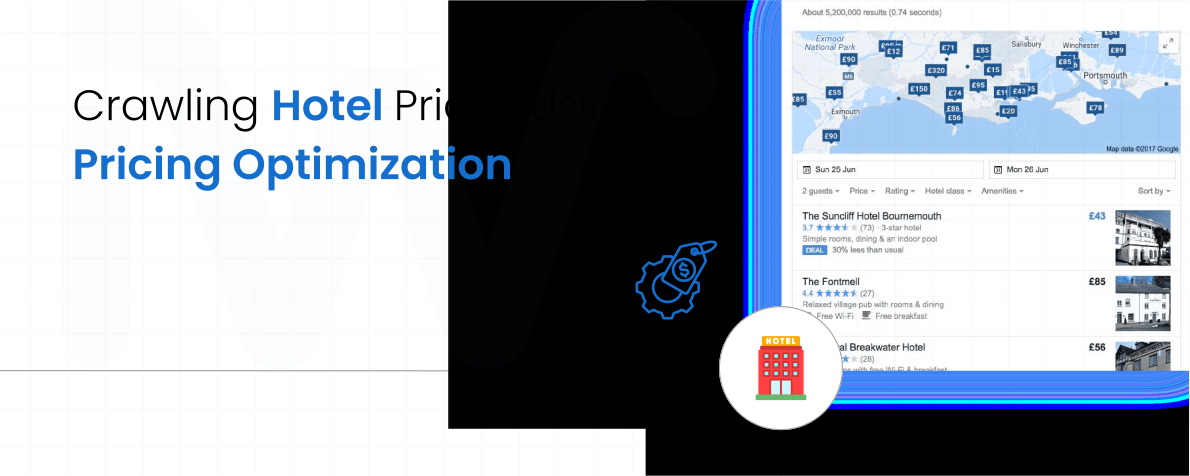
Crawling Hotel Prices Using Pricing Optimization
Parth Vataliya
Reading Time: 0 min
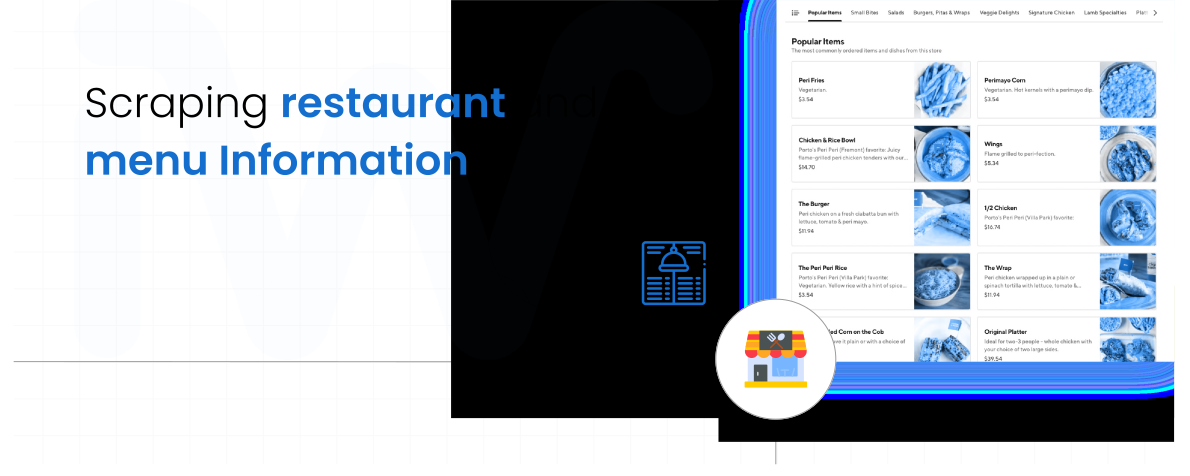
Scraping restaurant and menu Information
Parth Vataliya
Reading Time: 0 min
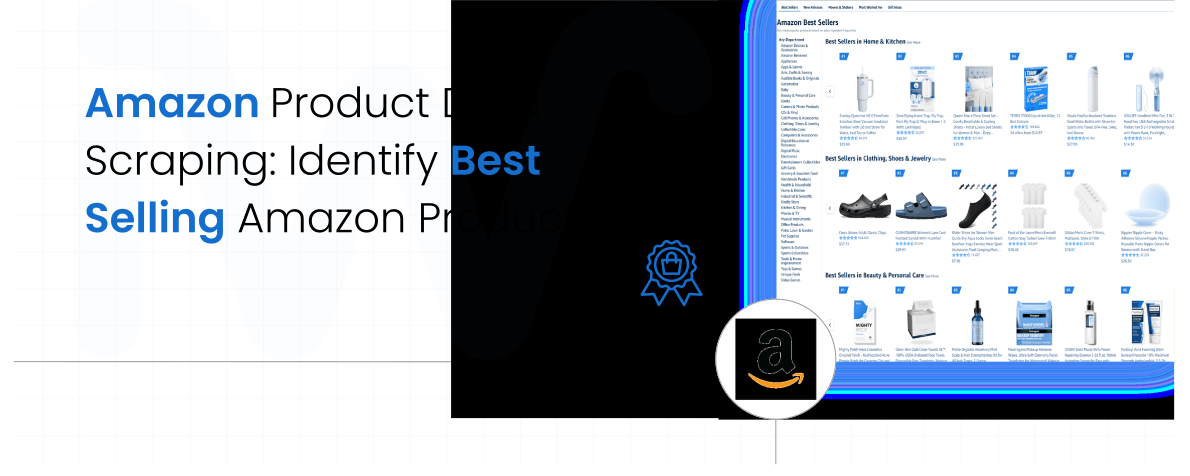
Amazon Product Data Scraping: Identify Best Selling Amazon Products
Parth Vataliya
Reading Time: 0 min
Build the Right Solution for You
Share your requirements, and we will definitely deliver a solution that will satisfy your needs perfectly!
Quick Response
Fast replies guaranteed
Expert Team
Driven by expertise
Secured Process
Built with strong security
Ongoing Support
Support whenever you need
Save Time & Money
Bulk data delivery in less time.
Complex & Varied Data
Hassle-free handling of JavaScript, logins, APIs, and dynamic.
Custom-Built Pipeline
Designed as per your requirements and scalability.